Friday, 1 February 2013

Evolution

Kelvin Okafor is a young British artist, who creates hyper-realistic drawings using charcoal and a variety of pencils. 

In digital images of his finished work it is hard to believe that these images are drawings. 

On his site he has an amazing sequence of 54 images called Mana - Evolution, which shows the stages of the creation of one of his drawings. 

Below is image 30/54 from this sequence.


Image copyright K. Okafor

Wednesday, 30 January 2013

Winter Sun

This photo was taken on the 27th January in West-Kirby in the North West of the UK. The colours haven't been modified - it was an unseasonal blue sky and it was warm.


Minya Konka


The British travel writer Robert Macfarlane recently published The Old Ways: A Journey on Foot, a superb book describing his journeys on land and sea over a couple of years. In this book he has a chapter called Ice, that describes his expedition to Minya Konka, one of the highest mountains outside of the Himalayas (7556 Meters high) (a full extract of this chapter is available HERE). 

Minya Konka is an incredibly tough mountain to climb - Macfarlane claims that up to 1999 more climbers had died trying to climb the mountain than had reached the summit.

Back in 1930 the famous Swiss geographer Eduard Imhof  traveled to Chinese Tibet to  measure the position and elevation of Minya Konka. He was accompanied by Paul Nabholz and Arnold Heim.

While working there Imhof lived in a Tibetan monastery at the foot of the mountain. He estimated that the elevation of Minya Konka was 7590 metres. 

The Eduard Imhof archive has some superb illustrations made by Imhof from this expedition (HERE). 

The image below is one of Imhof's sketches of Minya Konka:

Friday, 25 January 2013

A hidden snake

Abbott Thayer is widely refered to as the father of camouflage. His Wikipedia entry (HERE) says the following;

"Abbott Handerson Thayer (August 12, 1849 – May 29, 1921) was an American artist, naturalist and teacher. As a painter of portraits, figures, animals and landscapes, he enjoyed a certain prominence during his lifetime, as indicated by the fact that his paintings are part of the most important U.S. art collections. During the last third of his life, he worked together with his son, Gerald Handerson Thayer, on a major book about protective coloration in nature, titled Concealing-Coloration in the Animal Kingdom: An Exposition of the Laws of Disguise Through Color and Pattern; Being a Summary of Abbott H. Thayer’s Disclosures. First published by Macmillan in 1909, then reissued in 1918, it had an effect on the use of military camouflage during World War I. He also influenced American art by his efforts as a teacher who trained apprentices in his New Hampshire studio."
A copy of Concealing-Coloration in the Animal Kingdom: An Exposition of the Laws of Disguise Through Color and Pattern; Being a Summary of Abbott H. Thayer’s Disclosures is available at the Internet Archive to read or download (HERE).

An image of a Copperhead Snake on its own and hidden in dead leaves from Thayer's book is shown below (painted by A.H. Thayer and Rockwell Kent).


A piece in the Smithsonian magazine puts Thayer's controversial animal colouration ideas into a broader context (HERE). Early in his career the American artist Rockwell Kent worked  for Thayer.


Dazzle

During World War one British and American warships were camouflaged using Dazzle (or Razzle-Dazzle) painting (HERE).

One of the people who was most involved was the artist Edward Wadsworth who supervised the painting of over 2,000 ships and later painted both abstract compositions that look a little like a Dazzled ship and also realistic images of some of the ships he had painted. The image below was painted by Wadsworth and shows Dazzle ships in dry-dock in Liverpool 1919.


The Rhode Island School of Design has an extensive archive of images from the US navy showing some of the dazzle designs used in WW1 (HERE)


Up Goer Five - xkcd

The cartoonist XKCD has a brilliant blueprint of a Saturn 5 rocket annotated with only the top thousand most used words (Up Goer Five). This inspired Theo Sanderson to write an editor that helped people to create prose that only used the top thousand words HERE.  

Image Copyright XKCD.

Wednesday, 23 January 2013

Richard Edes Harrison - working methods

In the February 28th 1944 edition of Life magazine there was a multi-page article describing how Richard Edes Harrison created his distinctive global perspective maps (HERE see page 56). 


The article described Harrison's process - the six steps are summarised below. 

It is interesting to see what ingenuity he needed to create his distinctive views of the World. Standard maps created using the Mercator projection did not give him the specific viewpoints he was after. He therefore directly photographed a globe so that he could get the right perspective distortions of the shapes of countries right and the right curvature of the Earth. 

 The finished map above appeared under the title The Not-so-soft underside. A later version was published under the heading Europe from the South-West in 1944 by Alfred A. Knopf in Look At The World: The Fortune Atlas For world Strategy


Images copyright Life


Sunday, 20 January 2013

Everyday micro-mechanics

An automatic or self-winding mechanical wristwatch is a marvel of micro engineering. At the heart of this type of watch is the automatic movement that collects the energy of your arm moving and uses this energy to keep the movement wound up. For a detailed description of an automatic movement and its history see HERE.

To illustrate the mechanical complexity of an automatic watch here is a detailed image showing the main component parts of a Sellita SW240 automatic movement. 


Image copyright Sellita


Off the Map

The London Underground has a number of hidden and unused stations. Now in the 150th year anniversary of the Tube this site, Off The Map, has created new artwork to celebrate these overlooked stations.  The ten original artworks aim to bring to life the history and secrets of the stations and they will be on sale throughout the 150th Anniversary of the Tube.

Here is their write up on the Brompton Road station;

Brompton Road (1906 - 1934)
 
Following the relocation of the Knightbridge station entrance it was deemed uneconomical to keep Brompton Road station open. Operation ceased on 29th July 1934. Today, the station is hidden away behind a distinctive brick wall. It can still be seen when traveling on the Piccadilly Line; look out the right side of the train between Knightsbridge and South Kensington station.


Wallace's Malay Archipelago


Alfred Russell Wallace (1823-1913) was a British naturalist who independently arrived at the theory of natural selection when he was recovering from malaria on a remote Indonesian island. He wrote a paper describing his idea and famously sent it to Charles Darwin for his views. By rights Darwin should have sent the paper on to a suitable journal with a recommendation that it be published, thereby giving Wallace scientific priority for a radically new, and essentially correct, way of understanding nature.

But that isn't what happened. Darwin talked it over with a few influential chums and they cooked up a way of presenting Wallace's paper and a hastily written paper by Darwin at the same meeting of the Linnean Society in London in July 1858.

The first page of the paper from the proceedings of the Linnean society is shown below (from HERE


The Natural History museum will begin a celebration of 100 years since Wallace's death this week (more HERE). An archive of his letters has just been put online HERE.

Wallace was a great Victorian travel writer and perhaps his best known volume is The Malay Archipelago. The Internet Archive has a full copy online of the 1869 edition of The Malay Archipelago: the land of the orang-utan, and the bird of paradise (HERE).

Recently the Guardian reviewed this classic (HERE).

Below is a map from the book showing the island of Borneo (now split between three countries Brunei, Indonesia and Malaysia) on the same scales as the British Isles (now split between two countries Eire and the UK). Wikipedia lists the area of Borneo as 743,330 km2 and the British Isles as 315,134 km2.


The book is well illustrated - an example here is a full page illustration of three new species of beetle from the Moluccan islands. 


Friday, 18 January 2013

E Powys Mathers


The scholar and poet Edward Powys Mathers (1892–1939) was also one of the early pioneers of the cryptic crossword. Between 1926 and 1939 he composed nearly 700 crosswords for The Observer newspaper in the UK, under the pseudonym Torquemada. Many of these crosswords were incredibly difficult - and even now when cryptic puzzles are much more commonplace, his puzzles are still considered as difficult. One of Mathers' innovations was a crossword format that didn't have any black squares. 

The image below is a copper engraving of E. Powys Mathers by the artist Hester Sainsbury


Powys Mathers was also keen on translating poetry - one of the most famous of his translations is his free verse translation of the poem Caurapâñcâśikâ by Kavi Bilhana an 11th-century Kashmiri poet. 

The Mathers translation was published as The Black Marigolds in Oxford by Blackwell in 1919. This translation runs to about 50 stanzas (HERE).  John Steinbeck quoted extensively from The Black Marigolds in his book Cannery Row.  

The Welsh poet Vernon Watkins thought that The Black Marigolds was the most beautiful love poetry he knew of.


Digital Clock

Here is Form Follows Function (fff) a set of very interactive demonstrations of HTML 5 by Jongmin Kim. 


The image below is from a Flip Clock that picks up the system time from the computer. 


Path of Beauty

This short film follows a young woman walking around a completely deserted Louvre. It was directed by Florent Igla. 


This still shows the young woman sitting in front of the vast "Raft of the Medusa" by Théodore GÉRICAULT (Rouen, 1791 - Paris, 1824). The original is over 7 metres wide. A detailed description of the painting is HERE on Wikipedia.

Thursday, 17 January 2013

Dynamic Wind Map

Here is a still from a dynamic wind map created by Hint.fm. 

The makers say the following:

The wind map is a personal art project, not associated with any company. We've done our best to make this as accurate as possible, but can't make any guarantees about the correctness of the data or our software. Please do not use the map or its data to fly a plane, sail a boat, or fight wildfires :-) 

US Gasoline Prices and Miles Per Annum

Here is a superb infographic by Hannah Fairfield from the New York Times in 2010 - plotting the cost of a gallon of gas versus number of miles driven per annum by US drivers (HERE). 

It is essentially a scatter plot - but because the unfolding of this relationship over time is relatively straightforward the designer has joined the dots. This gives a unique way of looking at the two variables per yearly data point. 


The graphic is Copyright New York Times

Sunday, 13 January 2013

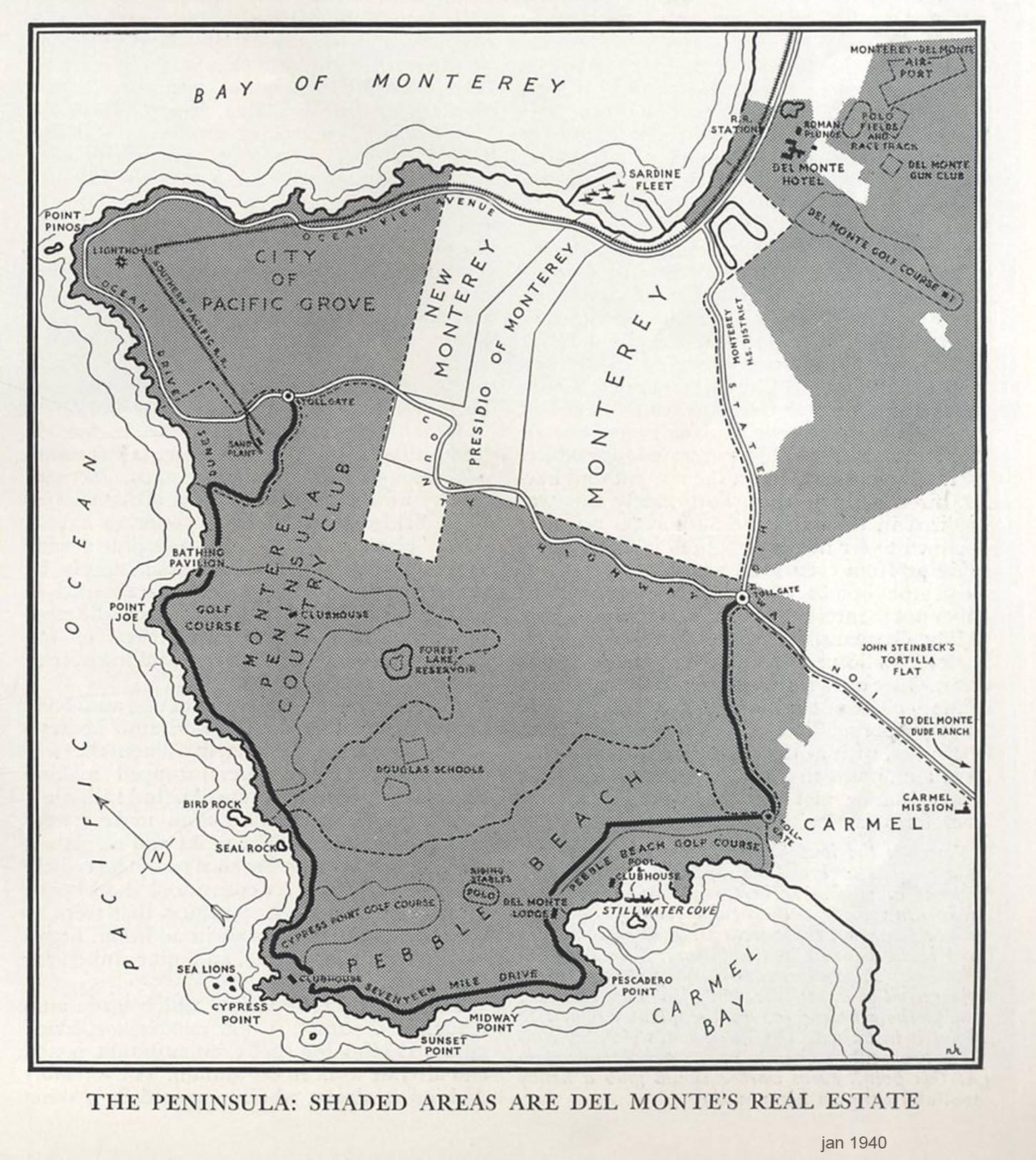
Monterey Peninsula 1940

Here is a detailed map of the Monterey Peninsula from the January 1940 edition of Fortune magazine. The shaded areas show the real estate owned by the Hotel Del Monte (which was at the start of the 17 mile drive which fanously leads to Pebble Beach golf course).

It indicates the location of John Steinbecks Tortilla Flat (published 1935 - see HERE) and Oceanview Avenue, site of the Sardine canneries and later re-named Cannery Row - subject of a later Steinbeck novella Cannery Row (published in 1945 - see HERE).

I had added a yellow dot at the approximate location of Ed Ricketts lab which was sited on Oceanview Avenue.  

Image from Chris Mullens incomparable archive HERE


Thursday, 10 January 2013

The Unanticipated Consequences of Purposive Social Action

I always thought that one of the big differences between the physical sciences and social sciences is that in the physical sciences, regardless of everything else, the laws of physics act always and everywhere the same. This is independent of whether human beings either understand the laws or have a way of using them. So, for example, gravity acts on everything in the universe, always. 

This means that as science develops the explanations that are put forward to explain a phenomena, no matter how complex, are constrained by physical law (see the First Law of Biology HERE). In the social sciences this is generally not the case. There is not a law in social science that is analagous with gravity (except of course gravity does act on all human beings all the time, but generally this doesn't seem to affect how people act).

However, I have just found an example of a law of social science; the law of unintended consequences, that may be like gravity in that it is at work always and everywhere (Wikipedia entry HERE and Encyclopedia of economics entry HERE).

The law has been discussed by philosophers and economists for centuries (including Adam Smith, John Locke etc), but it was brilliantly explained by the sociologist Robert K Merton in a 1936 paper "The Unanticipated Consequences of Purposive Social Action" (HERE).
 
Merton lists listed five causes of unanticipated consequences [1] Ignorance, [2] Error [3]  Immediacy of interest - which can override a long-term interest [4]   Basic values. which may need  certain actions (or prohibit them) even if the long-term result might be unfavorable  and [5]  Self-defeating prediction. In which  the enunciation of the prediction actually leads to a change.

In 1936 he promised to write a book about this law, which he worked on until he died in 2003, but did not publish. Edward Tufte rates this article as "maybe the best paper ever in social science" (HERE).

You can find a PDF of the paper HERE.


Sunday, 6 January 2013

Great Circles on the Earth

Richard Edes Harrison (1901-1994) was a cartographer active in the 1940s. Harrison studied Zoology and Chemistry at Yale but graduated with architecture, he pursued scientific illustration in New York  and published his first map for $25 in 1932 in Time Magazine. Harrison does not have a Wikipedia entry but in the 1940's was very well known. You can find more on Harrison in a paper by Susan Schulten HERE.

In 1944 Alfred A. Knopf published an atlas of his distinctive large scale maps of the World drawn from the high perspective of "the air age";  Look At The World: The Fortune Atlas For world Strategy. The maps were drawn by Richard Edes Harrison and the text was written by the Editor of Fortune. 

This is a superb book and many of the images can be accessed and downloaded at the David Rumsey Map Collection website (HERE). 

For example the image below is an unusual gnomonic mapping showing the Earth from above the North pole. This mapping is used to show Great circles on the Earth surface. 


The enlarged portion below shows some routes. For example the route from London to New York is shown in this projection as a straight line, which indicates that on the surface of the Earth this is a great circle.   Note that the route goes via a North Atlantic track that leaves Europe near to Shannon airport in Western Ireland and arrives in North America over Botwood Newfoundland. 


 All images from David Rumsey Collection. Copyright Fortune 1944.


Friday, 4 January 2013

The Historical Geographies of Yi-Fu Tuan

Although academic institutes traditionally consider history and geography as two distinct subjects, the fact is that the temporal cannot ever be fully separated from the spatial. All of human social structuring, from the small scale structure of our family unit, to the large scale structure of human society, is context dependent. These structures involve the unfolding of historical geographies - the simultaneous making of history and construction of human geography. 
 
One of the people who has spent a liftime studying historical geographies is the interesting Chinese-American geographer Yi-Fu Tuan, born in Tientsin China in 1930. Tuan created a unique blend of human geography and philosophy and published many books and papers on the subject. A good profile on his life and work is given HERE and his description of his intellectual development and career is HERE.

Since 1985 YiFu has been sending regular Dear Colleague letters, then less frequent essays, to the members of his department at University of Wisconsin, Madison. An archive of these communications is HERE.

Tuan still walks every day between his appartment and his office - as an active emeritus professor at Madison. 

 Below a picture of Yi-Fu Tuan in the field in Arizona about 1954 (image from HERE).


Tuesday, 1 January 2013

Anatomy of Inspiration

One of the most entertaining blogs I found in 2012 was Brain Pickings. The Guardian just interviewed its curator Maria Popova HERE.

The Brain Pickings style is that Popova will often take an obscure offline source - often old books - and posts high quality images plus her own commentary. 

For example, Popova recently published a post drawing attention to An Anatomy of Inspiration by Rosamund Harding which was published in about 1942 . One of the quotations from the book that Popova oulls out, and which appeals to me, is the following;

"Originality depends on new and striking combinations of ideas. It is obvious therefore that the more a man knows the greater scope he has for arriving at striking combinations. And not only the more he knows about his own subject but the more he knows beyond it of other subjects. It is a fact that has not yet been sufficiently stressed that those persons who have risen to eminence in arts, letters or sciences have frequently possessed considerable knowledge of subjects outside their own sphere of activity."
In common with Data Deluge, Popova does not have any adverts on her site. For more Brain Pickings see HERE.

The image below is from  one of her recent posts on Isotype and Otto Neurath.


Wednesday, 12 December 2012

Archive of Scientific Illustrations

HERE is a mind boggling archive of thousands of scientific illustrations of many different styles and historical periods. 

The example below is an illustration of a Halichoeres daedalma from The fishes of Samoa. Washington, Government print off.,1906. The image is from HERE.


For further details on the taxonomic status of this species see HERE.

Saturday, 8 December 2012

The benefits of tea

The British love their tea. But they don't take it too seriously. Hiroyuki Suzuki does. HERE is his visual book that uses a unique colour coding to describe the benefits of 80 different teas. The combination of benefits creates what the author calls a "Ripple Chart" the more ripple, the more benefits. 


London Blitz Map

This website has mapped the complete census of bombs that landed on London during the Blitz (Oct 1940-June 1941). Users can search for dates and streets to see details of whne bombs landed. 

The image below shows how thoroughly London was bombed. 


Friday, 30 November 2012

A potters netsuke collection

The Hare with Amber Eyes is a book by Edmund de Waal - a potter. It describes his inheritance of an incredible collection of 264 antique Japanese Netsuke - tiny carved animals or ornaments. His website is here.

The Hare is shown below.


STYN Pinball Printer

Sam van Doorn has created a modified pinball machine that allows users to create a unique print - the pinball is modified so that a sheet of paper goes in it and the ball is inked. The final images look like colourful bubble chamber plots. His site is HERE.


Tuesday, 6 November 2012

Bear Hunt

One of the very best books for children is Michael Rosen & Helen Oxenbury's classic We're Going On a Bear Hunt  (HERE)

The Guardian has a great piece today in which the writer and illustrator describe how they made the book (HERE). 

Illustration: © 1989 Helen Oxenbury.


Sunday, 4 November 2012

An Examination into the Structure of the Cells of the Human Lungs

Although best know for botanical art Franz Bauer was also an excellent anatomical artist. 

Below is a figure from "An Examination into the Structure of the Cells of  the Human Lungs; with a View to Ascertain the Office They Perform in Respiration." by Everard Home and F. Bauer published in the Phil. Trans. R. Soc. Lond.  1827 117, 58-64. This paper and others with Bauer illustrations are available as PDF's from the Royal Society (HERE).

The figure caption reads:
 
Fig 1. represents 1/64th part of an inch of the external surface of the human lung, the cells of which are filled with quicksilver; magnified 20 diameters.

Fig. 2. a transverse section of 1/64th part of an inch of the human ling, in which the arteries are filled with red and the veins with yellow minute injection ; magnified 20 diameters.


Saturday, 3 November 2012

On making drawings of microscopic subjects

The Austrian botanical illustrator Franz Bauer came from a family of gifted artists (HERE).  Franz spent nearly 50 years at Kew gardens as a botanical artist (HERE).

Bauer was also one of the most keen eyed observers of his day. He used a range of microscopes and developed his own observation techniques. For example in November 1836 he wrote a letter to Andrew Pritchard describing his method for making accurate microscopic drawings. This letter was published in 1837 as an Appendix to Micrographia by C.R. Goring & Andrew Pritchard (HERE).

The Appendix written by Franz Bauer is entitled "On making drawings of microscopic subjects". Bauer used two ruled glass micrometers (or graticules) both ruled into squares that were 1/40th inch on their sides. One of the graticules was placed in the eyepiece and the other on the stage. The magnification of the microscope was then adjusted until an integral number of the eyepiece divisions fit into a single division of the stage graticule. This meant he could calculate magnification. He could then leave the maicroscope set up and remove the stage graticule. When he now drew what he saw on paper he first drew a sguare grid of one inch squares. Thus he could accurately record on paper the magnification of the object.

One of his figures is shown.

A is 2 1/2 400ths of an inch long and 1/900th inch wide.
B is 2/400ths of an inch long
C is 1/400th of an inch long
D is 1/800th of an inch

 
The three fossil animacules in E are about 1/1200th inch long

And from Bauers description;
 
"The globular fungi at F are 1-1600th part of an inch in diameter, and the very minute globules of blood at G are each about 1-2400th or 1-2500th part of an inch in diameter."

Note that 1/2500th of an inch is about 10 microns.

Red blood cells are 6-8 microns in diameter.


Thursday, 1 November 2012

Passion fruit pollen

HERE is a beautiful scanning electron microscopy image of three passion fruit pollen grains. Taken by    Louisa Howard - Dartmouth College EM Facility.


Tuesday, 30 October 2012

All things are made of atoms

At the heart of modern physics is the atomic hypothesis, the simple notion that the universe is fundamentally granular.

If, in some cataclysm, all scientific knowledge were to be destroyed, and only one sentence passed on to the next generation of creatures, what statement would contain the most information in the fewest words? I believe it is the atomic hypothesis (or atomic fact, or whatever you wish to call it) that all things are made of atoms — little particles that move around in perpetual motion, attracting each other when they are a little distance apart, but repelling upon being squeezed into one another. In that one sentence you will see an enormous amount of information about the world, if just a little imagination and thinking are applied.
Feynman, R.P., Leighton, R.B. and Sands, M. (1964). The Feynman Lectures on Physics. Addison Wesley. p1-2.


All things are made of atoms. Tiny particles that humans are unable to directly experience. Although we cannot see, hear, smell or feel individual atoms, there is abundant scientific evidence that they exist. After nearly two hundred years of experimental testing, the atomic hypothesis hasn't been falsified. Informally, many scientists would probably think of the atomic hypothesis as a fact.  Still, the idea remains counter intuitive. Matter does not readily reveal it's fundamental granularity. What we actually see and feel everyday is a continuous world.  

One of the people who took seriously the challenge of experimentally investigating the atomic hypothesis was the French scientist Jean Perrin (1870 – 1942). Perrin studied Brownian motion of minute particles suspended in liquids. His work verified Einstein’s theoretical explanation of this phenomenon.  It confirmed the atomic nature of matter and he won the Nobel Prize for Physics in 1926.

The figure below is a classic experimental image obtained by Perrin. The original text describing his observations is below;
The figure here reproduced shows three drawings obtained by tracing the segments which join the consecutive positions of the same granules of mastic at intervals of 30 seconds. It is the half of the mean square of such segments which verifies the formula of Einstein. One of these drawings shows 50 consecutive positions of the same granule. They only give a very feeble idea of the prodigiously entangled character of the real trajectory. If the positions were indicated second to second, each of these rectilinear segments would be replaced by a polygonal contour of 30 sides, relatively as complicated as the drawing here reproduced, and so on.
 Brownian Movement and Molecular Reality.
By M. Jean Perrin
Translated from the Annales de Chemie et de Physique 8me series
September 1909
by
F Soddy M.A. F.R.S.


Available HERE.